Damaged Deliberations
April 2026–June 2027
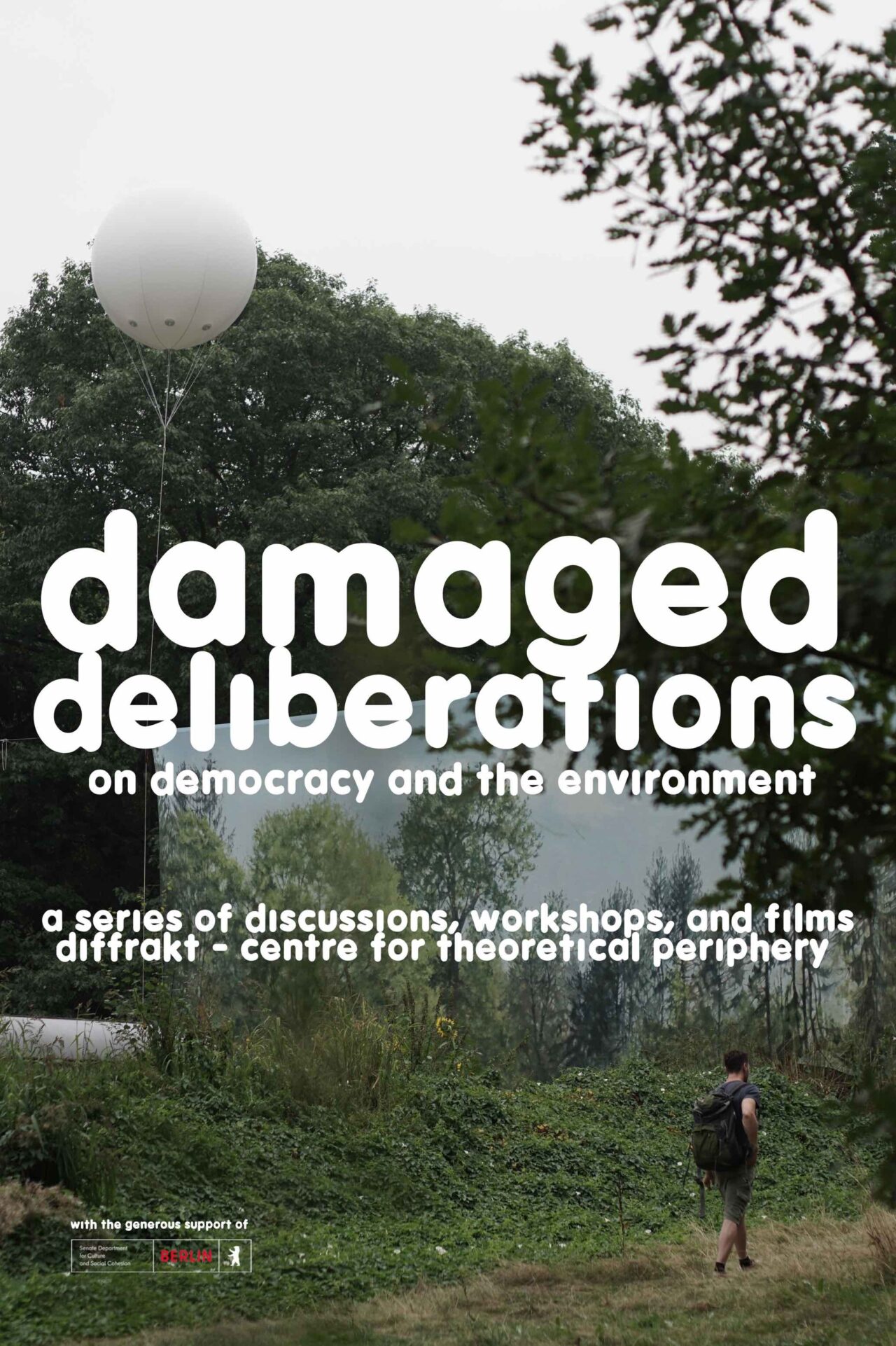
On Democracy and the Environment—a series of discussions, workshops, and films
Grappling with questions of the environment, ecology, and the climate crisis poses a fundamental challenge to familiar democratic structures—a challenge that, overshadowed by other crises and sidelined by institutional overload, political procrastination and powerful economic interests, furthermore is increasingly falling out of sight. Yet these issues touch on the foundations of how we (want to) live together: What is the relationship between the environment and democracy? What happens when individual freedom meets the necessity of limiting resources? And is it possible, maybe even necessary to conceive of a form of community that responds to the climate crisis not with less, but with more participatory decision-making?
 begins here—somewhere between art, theory, and activism. The event series explores different forms of collective deliberation—damaged, but not silenced. Rather than providing ready-made answers, it focuses on exploratory movements: on alternative horizons, on examples from the past and present, on practices that demonstrate that ecological responsibility and democracy need not be mutually exclusive. Eventually following these lines of flight might even provide opportunities to overcome limitations and exclusions of liberal democracy—intimately tied as it is to the nation-state modell, capitalist market economy and growth.
In open formats—workshops, screenings, and discussions— invites artists, theorists, and activists to explore, together, positions along the themes of  ,
,  ,
,  ,
,  , and
, and  that can lead beyond a dichotomous juxtaposition of environment and democracy.
Featuring works and contributions by Marwa Arsanios, Aline Baiana, Alyssa Battistoni, Jacob Blumenfeld, Kylie Crane, Sophia Doyle, Baldeep Kaur, Sam Lubicz, Milo Probst, Total Refusal, Gala Rexer, Daniela Russ, Anna Zett, and others.
Concept and organization: Caroline Adler, Morten Paul, Hannah Wallenfels for diffrakt.
The chapter examines the diverse, often contradictory, and at the same time highly politicized relationships to land—as “land and soil,” territory, object of speculation, and the very place and site of (national, individual, local, and also subversive) identity formation.
April 2026 – Screening and Conversation with Aline Baiana
May 2026 – Screening and Conversation with Sam Lubicz
May 2026 – Workshop with Sophia Doyle & Åsa Sonjasdotter at prinzessinnengarten kollektiv
The biological nuclear family is seen, especially in times of crisis, as a safe haven that is supposed to provide guidance, stability, and meaning. In this context, seemlingy unpolitical conceptions of family come to shape our everyday lives, our relationships with one another and with our wider environment—and ultimately even our relationship with nature itself. The chapter investigates the political ramifications of concepts of family and asks about their transformative potential.
June 2026 – Screening and Conversation with Marwa Arsanios
July 2026 – Workshop with Gala Rexer & Alyssa Battistoni
Everyone is familiar with waste, at least in the household. Yet its dimensions—including the social, economic, political, and material systems and infrastructures that produce waste and wastefulness as well as outsource its costs to the periphery—often remain hidden from us. The chapter focuses precisely on these otherwise invisible (infra-)structures and examines the conditions of their reproduction, as well as the relationships (with land, people, or political utopias) that they enable or render impossible.
September 2026 – Workshop with Baldeep Kaur & Kylie Crane
October 2026 – Screening and Conversation with Anna Zett
The climate crisis poses new challenges to established democratic procedures: What happens to sometimes lengthy democratic processes in the face of an escalating climate catastrophe? This question is often answered in such a way that democracy and environmental protection are presented as opposites, a framing mostly welcome to both populist politicans and the fossil industries. By contrast, the chapter asks what a community resilient to climate change and crisis might look like that goes hand in hand with an expansion of democratic participation and possibilities for shaping society, rather than with their restriction.
October 2026 – Conversation with Daniela Russ & Jacob Blumenfeld (tbd, in German)
Speculation on resources appears to be a fundamental obstacle to transparent and democratic climate policy. The chapter however wants to develop forms of storytelling that reveal new relationships with nature—one that is no longer viewed simply as a resource. It examines historical episodes of a potentially emancipated “state of exception” and their material legacies, and explores their promises through artistic and narrative means.
May 2027 – Workshop with Milo Probst, Anna Zett, and others (tbd, in German)
June 2027 – Workshop with Total Refusal (tbd)
About
On Democracy and the Environment—a series of discussions, workshops, and films
Grappling with questions of the environment, ecology, and the climate crisis poses a fundamental challenge to familiar democratic structures—a challenge that, overshadowed by other crises and sidelined by institutional overload, political procrastination and powerful economic interests, furthermore is increasingly falling out of sight. Yet these issues touch on the foundations of how we (want to) live together: What is the relationship between the environment and democracy? What happens when individual freedom meets the necessity of limiting resources? And is it possible, maybe even necessary to conceive of a form of community that responds to the climate crisis not with less, but with more participatory decision-making?
begins here—somewhere between art, theory, and activism. The event series explores different forms of collective deliberation—damaged, but not silenced. Rather than providing ready-made answers, it focuses on exploratory movements: on alternative horizons, on examples from the past and present, on practices that demonstrate that ecological responsibility and democracy need not be mutually exclusive. Eventually following these lines of flight might even provide opportunities to overcome limitations and exclusions of liberal democracy—intimately tied as it is to the nation-state modell, capitalist market economy and growth.
In open formats—workshops, screenings, and discussions— invites artists, theorists, and activists to explore, together, positions along the themes of , , , , and that can lead beyond a dichotomous juxtaposition of environment and democracy.
Featuring works and contributions by Marwa Arsanios, Aline Baiana, Alyssa Battistoni, Jacob Blumenfeld, Kylie Crane, Sophia Doyle, Baldeep Kaur, Sam Lubicz, Milo Probst, Total Refusal, Gala Rexer, Daniela Russ, Anna Zett, and others.
Concept and organization: Caroline Adler, Morten Paul, Hannah Wallenfels for diffrakt.
The chapter examines the diverse, often contradictory, and at the same time highly politicized relationships to land—as “land and soil,” territory, object of speculation, and the very place and site of (national, individual, local, and also subversive) identity formation.
April 2026 – Screening and Conversation with Aline Baiana
May 2026 – Screening and Conversation with Sam Lubicz
May 2026 – Workshop with Sophia Doyle & Åsa Sonjasdotter at prinzessinnengarten kollektiv
The biological nuclear family is seen, especially in times of crisis, as a safe haven that is supposed to provide guidance, stability, and meaning. In this context, seemlingy unpolitical conceptions of family come to shape our everyday lives, our relationships with one another and with our wider environment—and ultimately even our relationship with nature itself. The chapter investigates the political ramifications of concepts of family and asks about their transformative potential.
June 2026 – Screening and Conversation with Marwa Arsanios
July 2026 – Workshop with Gala Rexer & Alyssa Battistoni
Everyone is familiar with waste, at least in the household. Yet its dimensions—including the social, economic, political, and material systems and infrastructures that produce waste and wastefulness as well as outsource its costs to the periphery—often remain hidden from us. The chapter focuses precisely on these otherwise invisible (infra-)structures and examines the conditions of their reproduction, as well as the relationships (with land, people, or political utopias) that they enable or render impossible.
September 2026 – Workshop with Baldeep Kaur & Kylie Crane
October 2026 – Screening and Conversation with Anna Zett
The climate crisis poses new challenges to established democratic procedures: What happens to sometimes lengthy democratic processes in the face of an escalating climate catastrophe? This question is often answered in such a way that democracy and environmental protection are presented as opposites, a framing mostly welcome to both populist politicans and the fossil industries. By contrast, the chapter asks what a community resilient to climate change and crisis might look like that goes hand in hand with an expansion of democratic participation and possibilities for shaping society, rather than with their restriction.
October 2026 – Conversation with Daniela Russ & Jacob Blumenfeld (tbd, in German)
Speculation on resources appears to be a fundamental obstacle to transparent and democratic climate policy. The chapter however wants to develop forms of storytelling that reveal new relationships with nature—one that is no longer viewed simply as a resource. It examines historical episodes of a potentially emancipated “state of exception” and their material legacies, and explores their promises through artistic and narrative means.
May 2027 – Workshop with Milo Probst, Anna Zett, and others (tbd, in German)
June 2027 – Workshop with Total Refusal (tbd)


