Archive of a Defeated Generation ❘ Walter Benjamin and the Origins of Critical Theory
Seminar-workshop with
Caroline Adler | Franziska Aigner | Howard Caygill | Maria Chehonadskih | Sam Dolbear | Cooper Francis | Louis Hartnoll | Mimi Howard | Christian Voller
Organized by the Centre for Research in Modern European Philosophy (CRMEP), Cooper Francis and Daniel Gottlieb
Please find the detailed program below. +++ Fully booked. If you would like to be put on the waiting list, please send an email to mail@diffrakt.space with “Walter Benjamin Workshop” in the subject line. +++
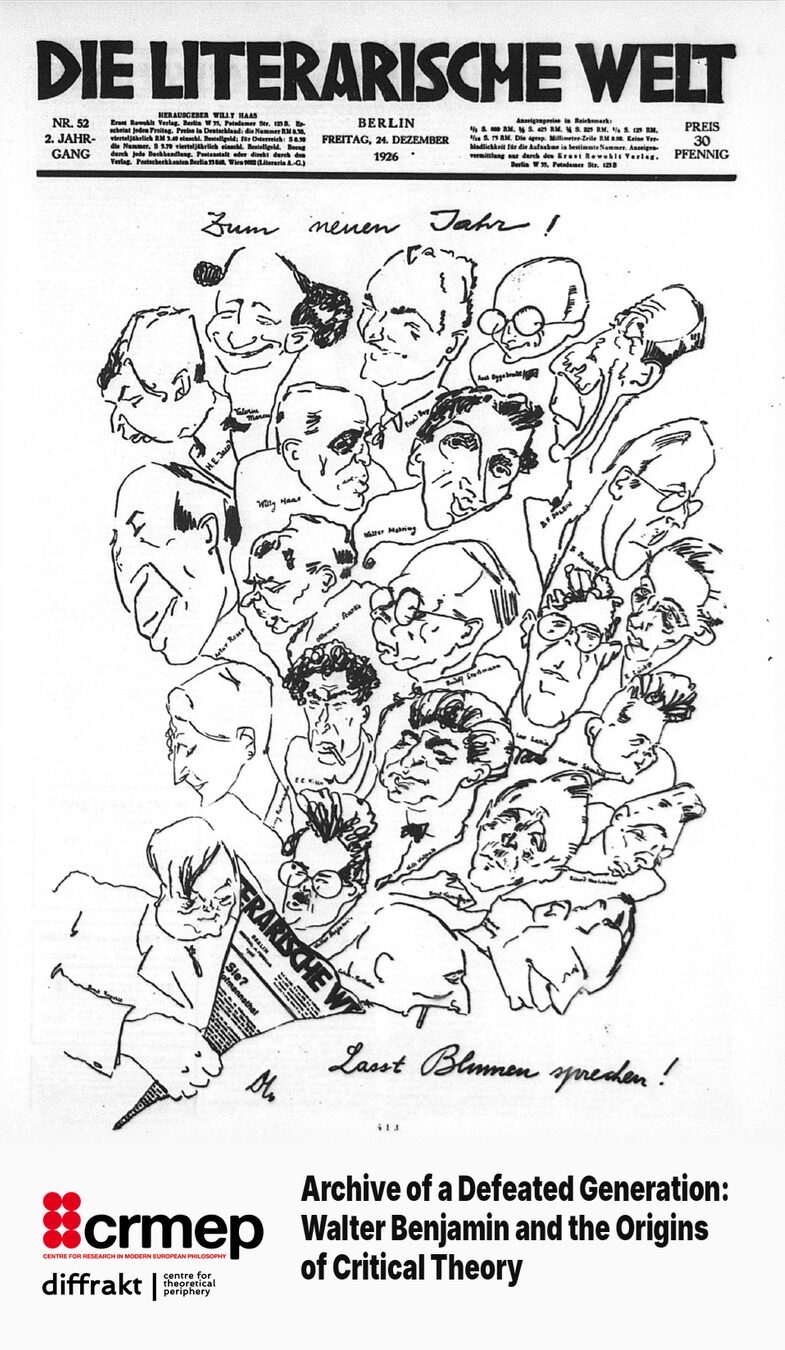
Walter Benjamin understood, well in advance, that “the only image our generation will leave is that of a defeated generation [as] its legacy to those who come.” Philosophy and the humanities have still not fully reckoned with the methodological consequences of this sentence.
The postwar image of the prewar period was formed, necessarily, from what survived: lives not extinguished, archives not destroyed, collections not dispersed beyond recovery, authorities still able to speak, edit, classify, and remember. Benjamin’s works and correspondence were first assembled by friends, certainly, but also by figures external to many of the most intimate constellations of his life — assembled, moreover, from those survivors, collections, and memories available to them. In Benjamin’s own autobiographical diagram, Theodor W. Adorno is absent, while Gershom Scholem appears as a node without connection. Yet it was substantially on the basis of such surviving authorities that the religious or “messianic” hypothesis concerning Benjamin’s thought was constructed; a hypothesis that, despite several later waves of archival expansion, remains one of the dominant frameworks of Benjamin scholarship.
This research workshop asks, ‘what changes when Benjamin’s thought is approached not from the retrospective authority of survival, but from the defeated and dispersed generative world out of which it emerged?’. Much contemporary work in the humanities remains governed by an archival positivism: what is not cited, named, or textually preserved cannot be avowed in interpretation. Yet the archive is never simply given: it is the historical remainder of destruction, exile, accident, friendship, hostility, institutional mediation, and editorial power. Even the most stringent philology presupposes a hypothesis that renders its findings intelligible. The question, then, is not whether interpretation may move beyond the archive, but how the archive itself demands a more rigorous account of its own absences. What is needed is not speculation against philology, but a speculative philology: a disciplined reconstruction of the vanished relations without which the surviving documents cannot be understood. Through the archaeology of a lost generation, this event looks to construct a space in which hypotheses transcendent to the archive can be formulated anew.
Following the event, CRMEP BOOKS will publish an anthology of the seminar papers, accompanied by some English translations of relevant texts by the figures discussed and also by Walter Benjamin himself.
Detailed Program
10–10.30am Introduction METHODOLOGICAL ISSUES
Cooper Francis, Schönflies and History as the “coloured rim of a crystalline simultaneity”
10.30am–12.30pm Panel I YOUTH
Mimi Howard, Youth Images (or, Benjamin in Freudenstadt)
Howard Caygill, Friedrich Heinle and the Sonnet Cycle
1.30–3.30pm Panel II NEO-KANTIANISM, MARXISM AND ART HISTORY
Franziska Aigner, From Anamnesis to the Unconscious: Herbertz, Leibniz, and Benjamin
Christian Voller, Alfred Seidel and Heidelberg Marxism
Louis Hartnoll, Carl Linfert and the Problem of Art Historiography
4–6pm Panel III BENJAMIN AND THE SOVIETS
Maria Chehonadskih, Benjamin’s Soviet Encounters
Caroline Adler, “I pressed him to put his cards on the table” – A Conversation between Walter Benjamin and Joseph Roth, Moscow 1926
Sam Dolbear, On Spark-gap Relations: Or, Sasha Stone
About
Please find the detailed program below. +++ Fully booked. If you would like to be put on the waiting list, please send an email to mail@diffrakt.space with “Walter Benjamin Workshop” in the subject line. +++
Walter Benjamin understood, well in advance, that “the only image our generation will leave is that of a defeated generation [as] its legacy to those who come.” Philosophy and the humanities have still not fully reckoned with the methodological consequences of this sentence.
The postwar image of the prewar period was formed, necessarily, from what survived: lives not extinguished, archives not destroyed, collections not dispersed beyond recovery, authorities still able to speak, edit, classify, and remember. Benjamin’s works and correspondence were first assembled by friends, certainly, but also by figures external to many of the most intimate constellations of his life — assembled, moreover, from those survivors, collections, and memories available to them. In Benjamin’s own autobiographical diagram, Theodor W. Adorno is absent, while Gershom Scholem appears as a node without connection. Yet it was substantially on the basis of such surviving authorities that the religious or “messianic” hypothesis concerning Benjamin’s thought was constructed; a hypothesis that, despite several later waves of archival expansion, remains one of the dominant frameworks of Benjamin scholarship.
This research workshop asks, ‘what changes when Benjamin’s thought is approached not from the retrospective authority of survival, but from the defeated and dispersed generative world out of which it emerged?’. Much contemporary work in the humanities remains governed by an archival positivism: what is not cited, named, or textually preserved cannot be avowed in interpretation. Yet the archive is never simply given: it is the historical remainder of destruction, exile, accident, friendship, hostility, institutional mediation, and editorial power. Even the most stringent philology presupposes a hypothesis that renders its findings intelligible. The question, then, is not whether interpretation may move beyond the archive, but how the archive itself demands a more rigorous account of its own absences. What is needed is not speculation against philology, but a speculative philology: a disciplined reconstruction of the vanished relations without which the surviving documents cannot be understood. Through the archaeology of a lost generation, this event looks to construct a space in which hypotheses transcendent to the archive can be formulated anew.
Following the event, CRMEP BOOKS will publish an anthology of the seminar papers, accompanied by some English translations of relevant texts by the figures discussed and also by Walter Benjamin himself.
Detailed Program
10–10.30am Introduction METHODOLOGICAL ISSUES
Cooper Francis, Schönflies and History as the “coloured rim of a crystalline simultaneity”
10.30am–12.30pm Panel I YOUTH
Mimi Howard, Youth Images (or, Benjamin in Freudenstadt)
Howard Caygill, Friedrich Heinle and the Sonnet Cycle
1.30–3.30pm Panel II NEO-KANTIANISM, MARXISM AND ART HISTORY
Franziska Aigner, From Anamnesis to the Unconscious: Herbertz, Leibniz, and Benjamin
Christian Voller, Alfred Seidel and Heidelberg Marxism
Louis Hartnoll, Carl Linfert and the Problem of Art Historiography
4–6pm Panel III BENJAMIN AND THE SOVIETS
Maria Chehonadskih, Benjamin’s Soviet Encounters
Caroline Adler, “I pressed him to put his cards on the table” – A Conversation between Walter Benjamin and Joseph Roth, Moscow 1926
Sam Dolbear, On Spark-gap Relations: Or, Sasha Stone


