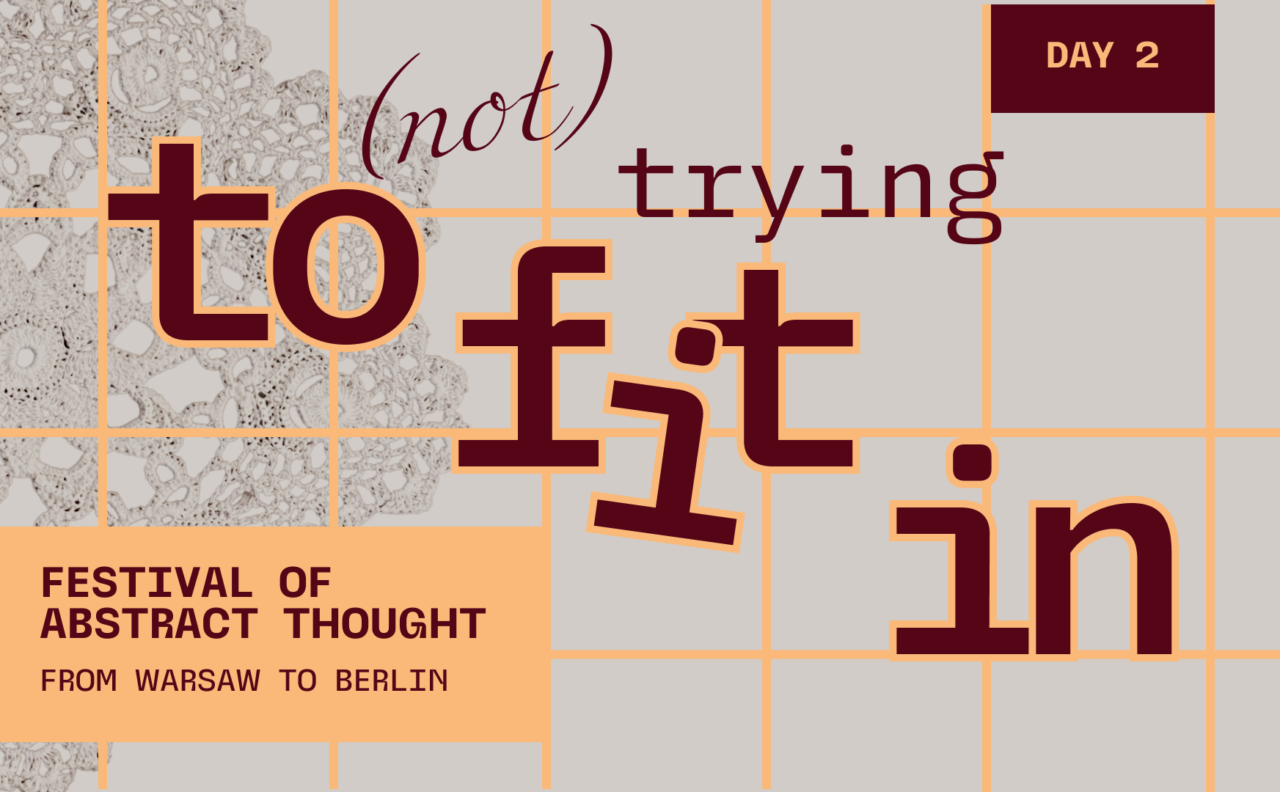
Festival of Abstract Thought in Berlin | (not) trying to fit in. Thoughts and practices from Warsaw to Berlin
Conversations and workshops with
Ania Kamecka | Ewa Majewska | Lilu | Magda Bocheńska | Michał Pospiszyl | nat skoczylas
After ten years in Warsaw, Festival of Abstract Thought brings its approach of collective public thinking to Berlin.
On the second day of the festival, we continue to occupy the in-between as a position that expands our thinking beyond what is visible from the center.: embrace being unfit and in-between, seeing what weirdness lives there and what coalitions can be built.
Programme
Eastern Affects and Hungry Ghosts (Workshop)
12:30 p.m. – 2:30 p.m.
lilu and nat are bringing together memories, erasures, affects, reflections on infrastructures, jars and tupperwares, un/savoury flavours, prejudices and prides that Eastern Europeans and East Germans share. What does persist in the sphere of erasure? What proposals around conviviality, solidarity, interdependence do we bring from the underworlds of countries that do not exist anymore on geopolitical maps – yet deeply affect and haunt us today. This session will be an initial gathering eventually leading to a game design – we encourage both those who want to be in a candid exchange and sharing just this one time, but also those who would want to develop a game with us, to come join us.
Feminist antifascism. Weak Resistance across the borders (Talk)
3:00 p.m. – 4:30 p.m.
This dialogic lecture engages with trans and queer theories from a feminist, critical perspective, working for a strategy of composting and making odd kin transversally across difference with a variety of perspective. This effort in theorizing is a way of solidarity and resistance of the weak, unfolding its antifascist stakes as it progresses, transnationally and across borders.
Escape Ecologies: Marshes, Forests, and Wastelands as Spaces of Resistance in Eastern Europe (Talk)
5:00 p.m. – 6:30 p.m
The influence of the natural environment on the formation of social relations in the past is an understudied topic, particularly in the context of Eastern European history. In this lecture, we will examine the influence of various ecosystems, from wastelands and forests to swamps and agricultural areas, on power relations, opportunities for resistance and the agency of subjugated groups, with a particular focus on the region’s 18th-century history. We will pay particular attention to elements of nature that have eluded administrative control and thus remained on the margins of research, such as reed beds, thickets, dense undergrowth, wastelands and weeds.
Taking these ‘illegible’ and hard-to-control spaces into account can shed new light on the history of various communities, their survival strategies, and their resistance.
Layer by layer: chimeric cartographies. Wax Pouring and the Polish Tradition of “Andrzejki” (Workshop)
7:00 p.m. – 9:00 p.m.
In this poetic sitting, we’ll explore together territories and topographies of community building. Letting ourselves sink into the long November night, together we’ll impersonate the mythical earth-divers from Slavic cosmology and embrace the magic of the Polish wax pouring in order to spill the spells of possible (and desired) futures. Still gathered along rivers, atop geological layers, now entangled in the nets of globalization, we are here, searching for togetherness and safety. The cartographies of the Western Slavs and stories of Polabians will become inputs from which we can mold the worlds we want to inhabit, rooting ourselves in one of the layers that Berlin is built on.
Exploring fantastical collages of lands built on top of lands, how can we allow ourselves to practice fortune-telling in the never-ending romance with the Earth we temporarily occupy?
Further details on the program and guests can be found on the festival website.
About
After ten years in Warsaw, Festival of Abstract Thought brings its approach of collective public thinking to Berlin.
On the second day of the festival, we continue to occupy the in-between as a position that expands our thinking beyond what is visible from the center.: embrace being unfit and in-between, seeing what weirdness lives there and what coalitions can be built.
Programme
Eastern Affects and Hungry Ghosts (Workshop)
12:30 p.m. – 2:30 p.m.
lilu and nat are bringing together memories, erasures, affects, reflections on infrastructures, jars and tupperwares, un/savoury flavours, prejudices and prides that Eastern Europeans and East Germans share. What does persist in the sphere of erasure? What proposals around conviviality, solidarity, interdependence do we bring from the underworlds of countries that do not exist anymore on geopolitical maps – yet deeply affect and haunt us today. This session will be an initial gathering eventually leading to a game design – we encourage both those who want to be in a candid exchange and sharing just this one time, but also those who would want to develop a game with us, to come join us.
Feminist antifascism. Weak Resistance across the borders (Talk)
3:00 p.m. – 4:30 p.m.
This dialogic lecture engages with trans and queer theories from a feminist, critical perspective, working for a strategy of composting and making odd kin transversally across difference with a variety of perspective. This effort in theorizing is a way of solidarity and resistance of the weak, unfolding its antifascist stakes as it progresses, transnationally and across borders.
Escape Ecologies: Marshes, Forests, and Wastelands as Spaces of Resistance in Eastern Europe (Talk)
5:00 p.m. – 6:30 p.m
The influence of the natural environment on the formation of social relations in the past is an understudied topic, particularly in the context of Eastern European history. In this lecture, we will examine the influence of various ecosystems, from wastelands and forests to swamps and agricultural areas, on power relations, opportunities for resistance and the agency of subjugated groups, with a particular focus on the region’s 18th-century history. We will pay particular attention to elements of nature that have eluded administrative control and thus remained on the margins of research, such as reed beds, thickets, dense undergrowth, wastelands and weeds.
Taking these ‘illegible’ and hard-to-control spaces into account can shed new light on the history of various communities, their survival strategies, and their resistance.
Layer by layer: chimeric cartographies. Wax Pouring and the Polish Tradition of “Andrzejki” (Workshop)
7:00 p.m. – 9:00 p.m.
In this poetic sitting, we’ll explore together territories and topographies of community building. Letting ourselves sink into the long November night, together we’ll impersonate the mythical earth-divers from Slavic cosmology and embrace the magic of the Polish wax pouring in order to spill the spells of possible (and desired) futures. Still gathered along rivers, atop geological layers, now entangled in the nets of globalization, we are here, searching for togetherness and safety. The cartographies of the Western Slavs and stories of Polabians will become inputs from which we can mold the worlds we want to inhabit, rooting ourselves in one of the layers that Berlin is built on.
Exploring fantastical collages of lands built on top of lands, how can we allow ourselves to practice fortune-telling in the never-ending romance with the Earth we temporarily occupy?
Further details on the program and guests can be found on the festival website.


