On the Politics of a “Friendship of Peoples”
Lecture performance and conversation with
Manca Arnuš | de_colonialanguage
In January 2026, Manca Arnuš and de_colonialanguage embarked on a three-month project to explore the concept of the “Friendship of Peoples”. This seemingly benevolent catchphrase, coined and promulgated by the USSR, proved too good to be true. Essentially, it served as an anti-imperialist facade both in internal and external Soviet policy, but at its core, it was a myth, deeply rooted in the automythologies of the USSR and the utopian socialist project.
The Friendship ideology permeated the textual, the visual, the architectural, the literal, the cultural, the public. It guaranteed equality between all fifteen socialist republics – but anchored in Moscow. It supported the rights of all ethnic minorities in the USSR – but in Russian. It championed the dissolution of the colonial empires and the newly emerged nation states in the “Global South” – but through the prism of an imperial and colonial logic. It gave – but it mostly took away.
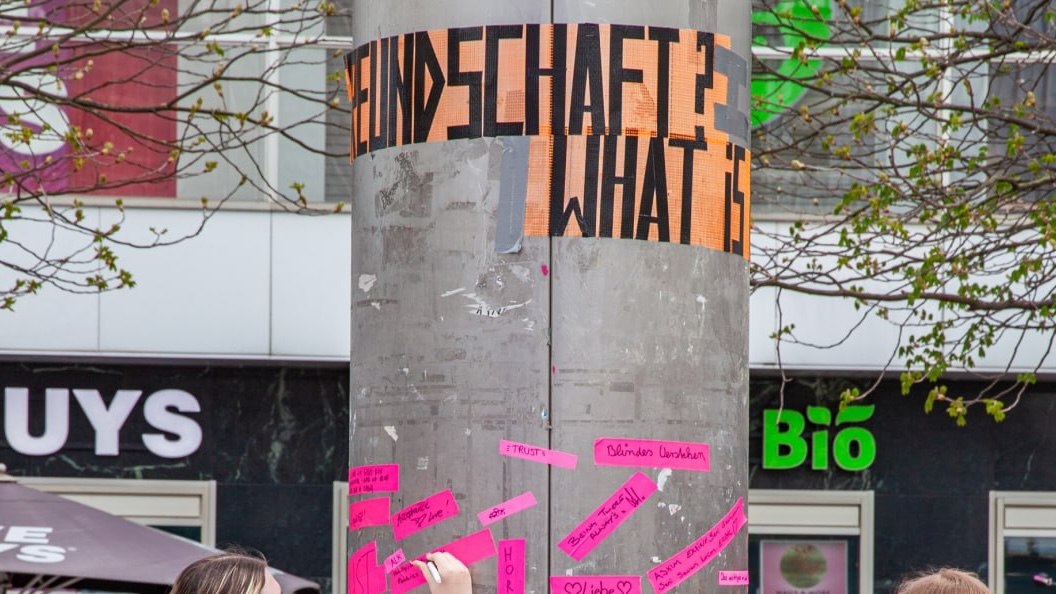
The exploration and dismantling of the myth of Soviet friendship was based on group readings, fieldwork, artistic and academic research, and the participatory practice of constructing a counter-monument to Friendship at the Open-Air Museum of Decoloniality on Alexanderplatz in March 2026, as the rhetoric of the Friendship of Peoples can be found manifested in different places in Berlin as well. Alexander’s Square features a Brunnen der Völkerfreundschaft (Friendship of Peoples Fountain), and, hidden among the Plattenbauten of Marzahn, there is a mosaic column dedicated to the Deutsch-Sowjetische Freundschaft (German-Soviet Friendship).
The results of this collaborative work will be presented and discussed in the format of a lecture performance grounded in conflict. Who is friends with whom? The drama will unfold in several acts, combining textual, audio, and bodily imagery of ideological friendship, reconfiguring the verticality of transactional friendship into its upturned mode: decentralized horizontality.
About
In January 2026, Manca Arnuš and de_colonialanguage embarked on a three-month project to explore the concept of the “Friendship of Peoples”. This seemingly benevolent catchphrase, coined and promulgated by the USSR, proved too good to be true. Essentially, it served as an anti-imperialist facade both in internal and external Soviet policy, but at its core, it was a myth, deeply rooted in the automythologies of the USSR and the utopian socialist project.
The Friendship ideology permeated the textual, the visual, the architectural, the literal, the cultural, the public. It guaranteed equality between all fifteen socialist republics – but anchored in Moscow. It supported the rights of all ethnic minorities in the USSR – but in Russian. It championed the dissolution of the colonial empires and the newly emerged nation states in the “Global South” – but through the prism of an imperial and colonial logic. It gave – but it mostly took away.
The exploration and dismantling of the myth of Soviet friendship was based on group readings, fieldwork, artistic and academic research, and the participatory practice of constructing a counter-monument to Friendship at the Open-Air Museum of Decoloniality on Alexanderplatz in March 2026, as the rhetoric of the Friendship of Peoples can be found manifested in different places in Berlin as well. Alexander’s Square features a Brunnen der Völkerfreundschaft (Friendship of Peoples Fountain), and, hidden among the Plattenbauten of Marzahn, there is a mosaic column dedicated to the Deutsch-Sowjetische Freundschaft (German-Soviet Friendship).
The results of this collaborative work will be presented and discussed in the format of a lecture performance grounded in conflict. Who is friends with whom? The drama will unfold in several acts, combining textual, audio, and bodily imagery of ideological friendship, reconfiguring the verticality of transactional friendship into its upturned mode: decentralized horizontality.


